Cloud & platform · deploy.pipelineCI passing
Autonomous Software Delivery Platform
Ships changes without anyone watching dashboards: progressive rollouts, statistical canary analysis and automatic rollback.
Open the live demo View the code Evaluation report Demo tour Run it ›_ last push 2 days ago
97.9%of bad versions rolled back on held-out worlds and held-back regression kinds (big-bang + alert: 66.1%)
1 of 208healthy versions rolled back (canary vs pre-deploy thresholds: 52)
37.5%of tests run per change, catching 99.8% of the bugs a full run catches
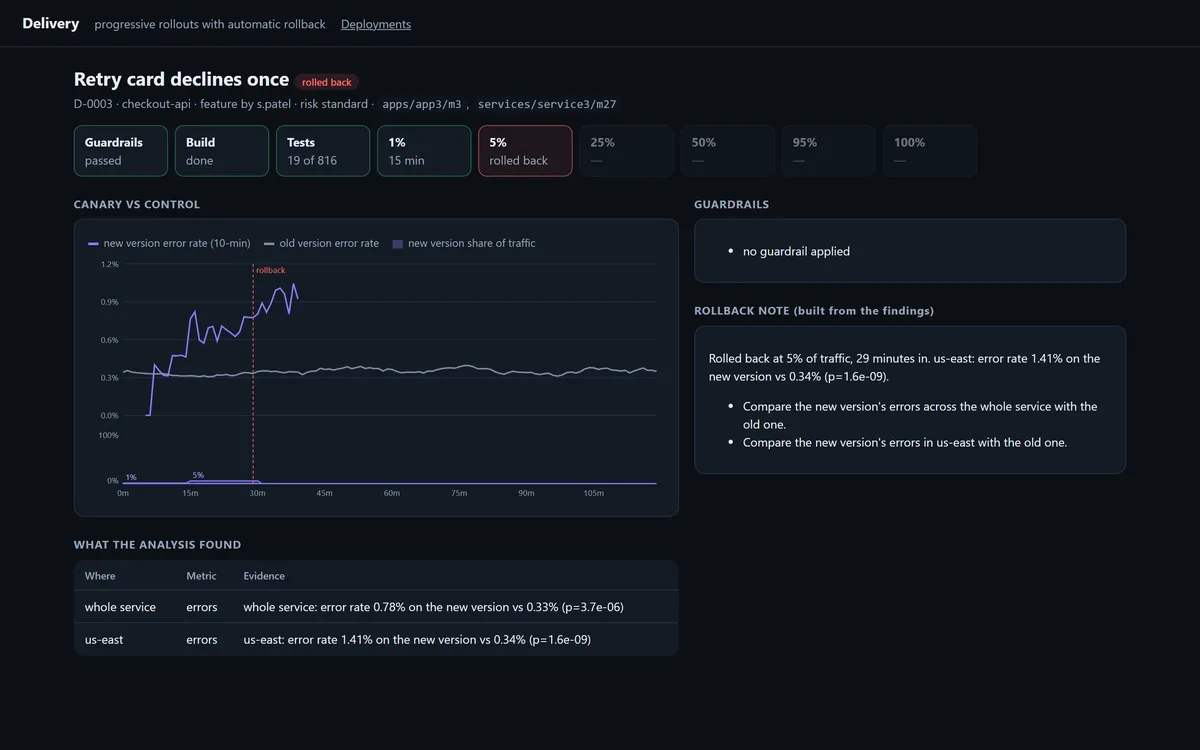
demo Demo tour
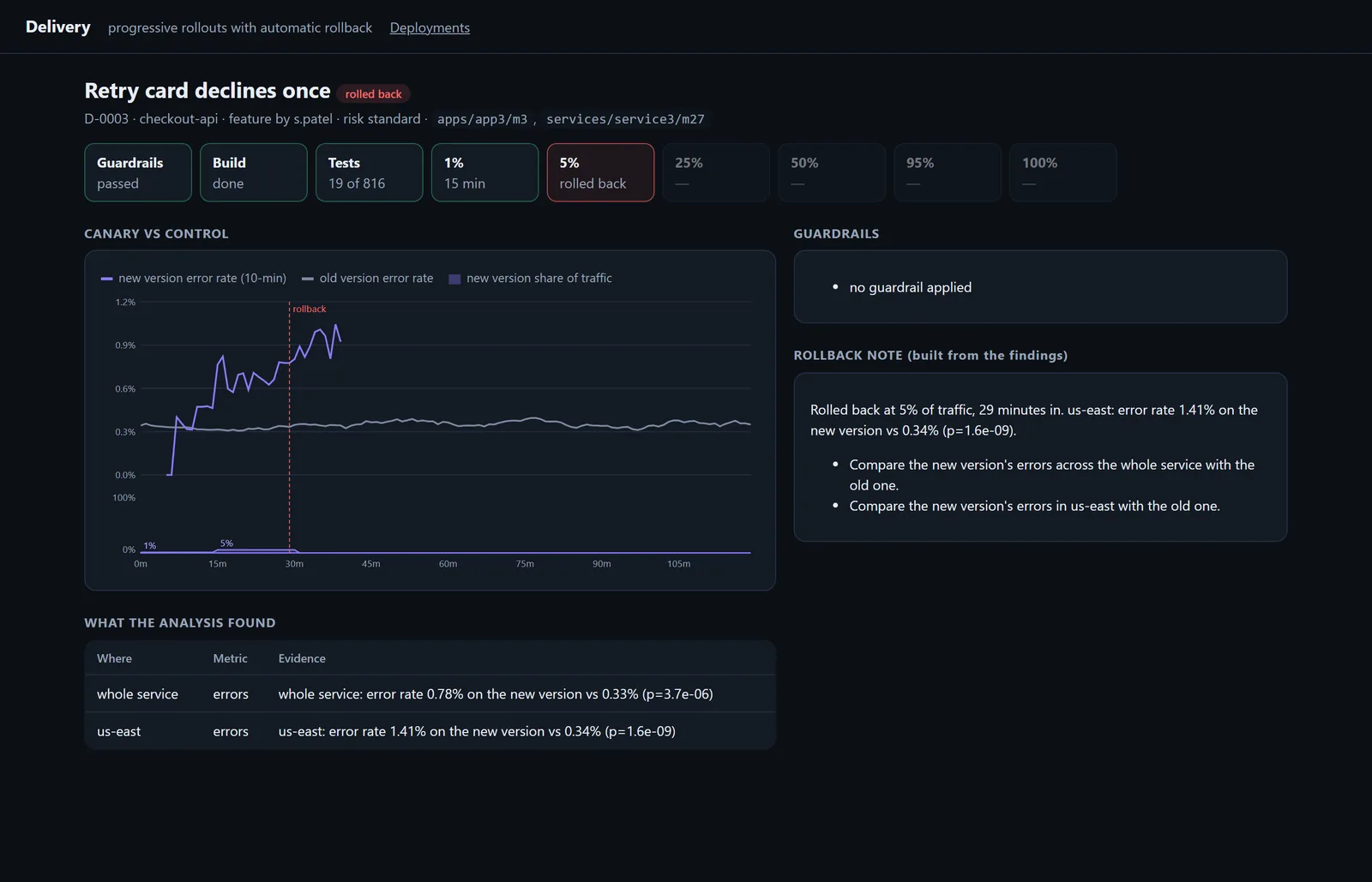
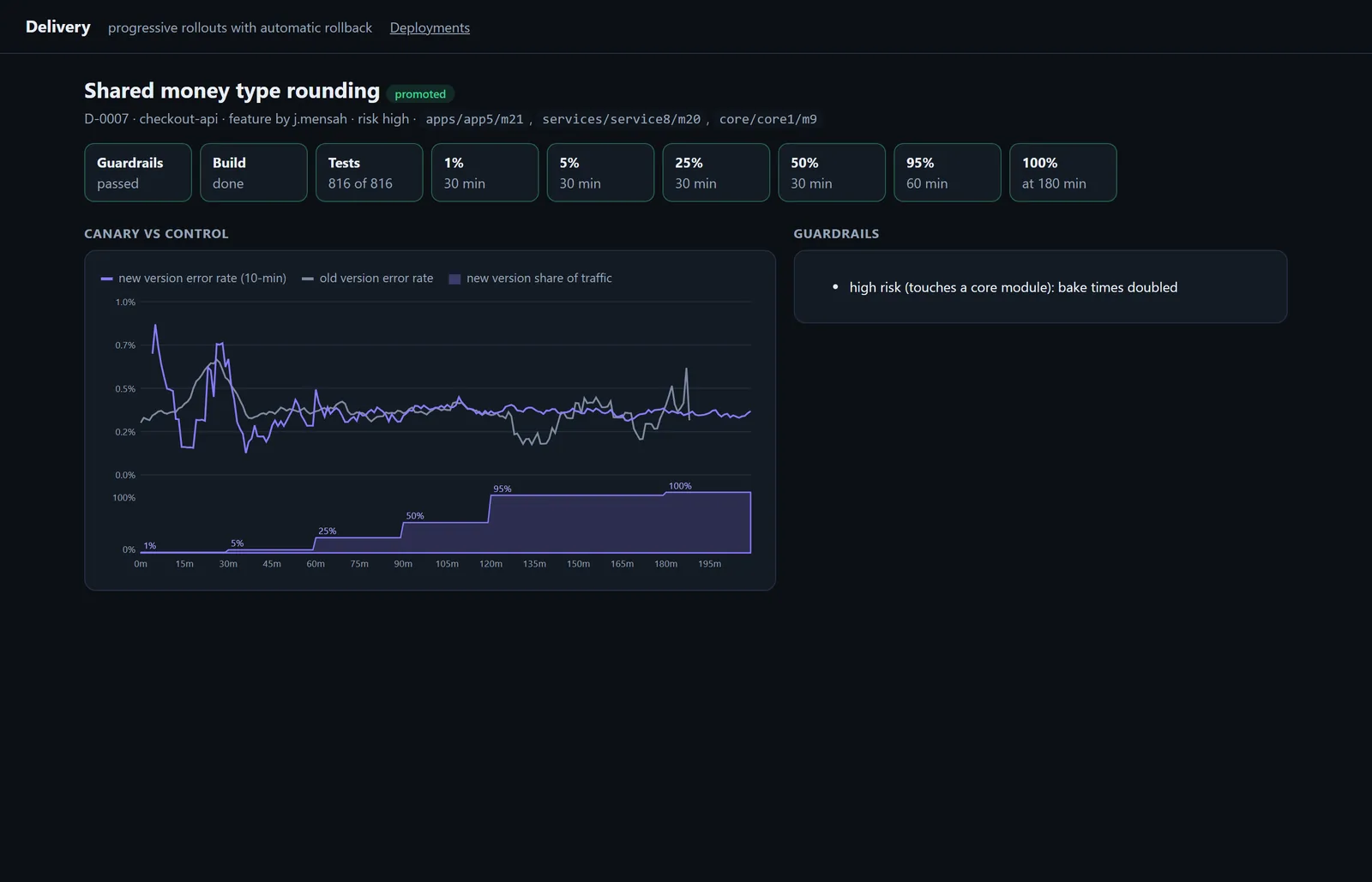
Screenshots from the running application, with its synthetic demo data. Select one to enlarge.


01 The problem
Bad releases are found by users, and the usual safeguards misfire: an alert after a big-bang deploy reacts once everyone is affected, and a canary compared with last hour's numbers rolls back healthy versions whenever something else goes wrong during the rollout.
02 How it works
- Change
- Guardrails
- Impact-selected tests
- 1% to 95% holdback
- Side-by-side canary analysis
- Promote or roll back + note
03 What I built
- Progressive rollouts (1% to a 95% holdback to 100%) with canary analysis every five minutes: the new version against the old one over the same minutes, for the whole service and every region, endpoint and cell, with exact tests and effect-size floors.
- Guardrails before a rollout (error budget, fast burn, change freezes, risky changes slowed and approved) and test impact analysis from the dependency graph, with known-flaky tests retried.
- Claude writing the rollback note from numbered findings; notes that cite missing findings, unflagged segments or numbers not in the evidence are replaced by the plain note.
04 What I learned
Pooling canary data across rollout steps made healthy versions look broken (Simpson's paradox: the traffic split changes between steps); analysing within each step fixed 21% false rollbacks.
Testing regions and endpoints, not just cells and the whole service, raised the catch rate from 84% to 99% on the tuning worlds with no extra false rollbacks.
05 Known limitations
Every repository documents what it doesn't do yet. The main ones:
- A simulated production service; no load balancer or service mesh is driven.
- Full rollout takes 90 minutes; stalls on the quietest endpoint are sometimes missed.
06 Stack
PythonSciPyNumPyClaude APIFastAPIDocker
The repository has the design document, operations runbook, full evaluation report and known limitations. All data is synthetic, generated by code in the repository.
run Run it yourself
Every project runs on a laptop: no cloud account and no paid API needed.
git clone https://github.com/codeROCK-IZZY/autonomous-software-delivery.git
cd autonomous-software-delivery
pip install -e ".[dev]" && pytest
deliver evaluate --gate                    # writes eval/reports/report.html