Cloud & platform · watch.mlopsCI passing
AWS MLOps Platform
Keeps a production model healthy after it ships.
View the code Demo tour Run it ›_ last push 1 week ago
0 monthsfrom each simulated change to its first alert
0 of 12false alarms on independent stable months
0.64 vs 0.58PR-AUC during drift, managed vs never retrained

demo Demo tour
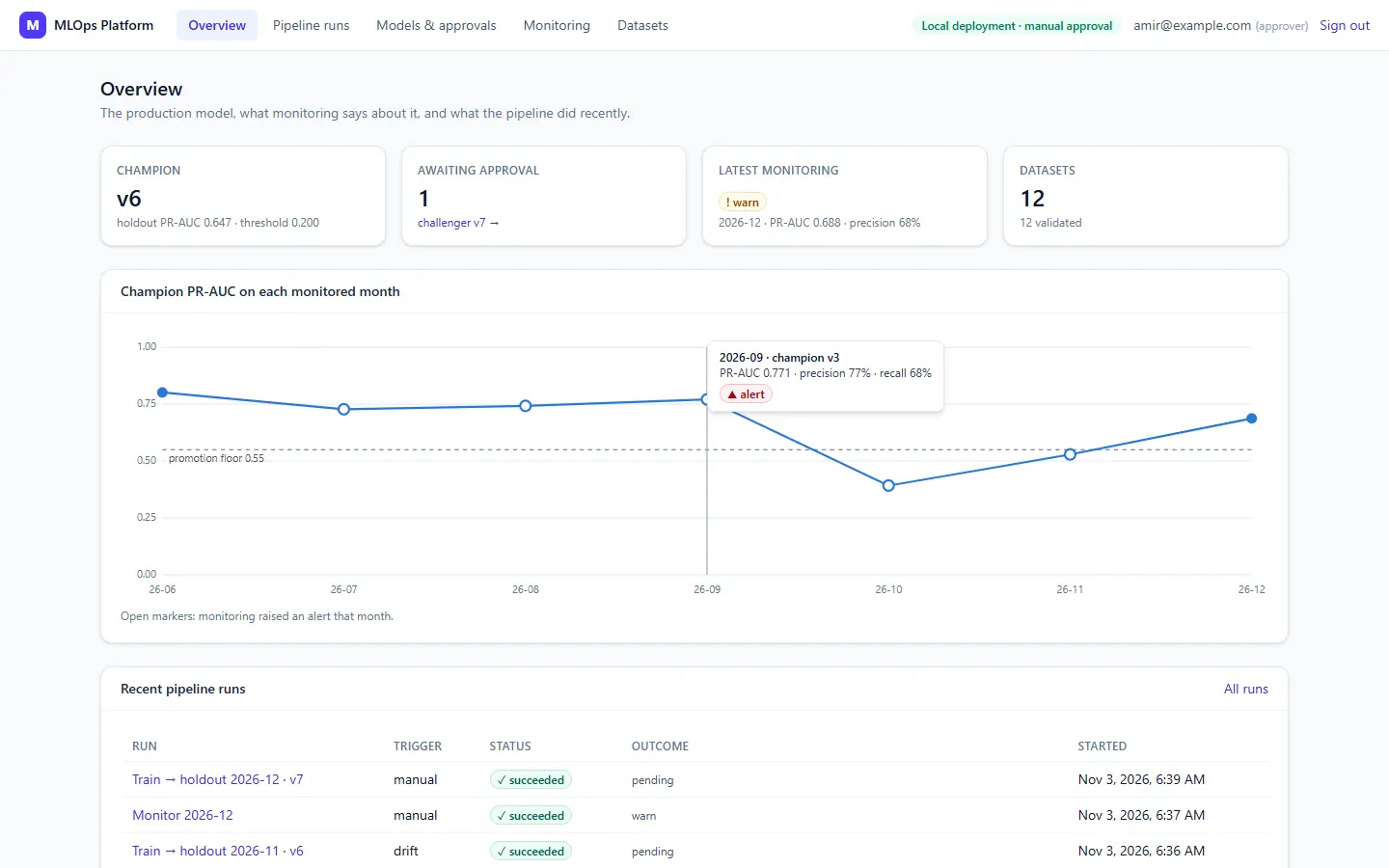
Screenshots from the running application, with its synthetic demo data. Select one to enlarge.


01 The problem
Most ML projects end at "the model works on the test set". In production the data keeps changing, models get quietly worse, scheduled retraining ships models nobody checked, and drift dashboards raise alarms nobody can act on.
02 How it works
- Monthly data batch
- Data contract + versioned S3
- Tracked training (MLflow)
- Gates vs. champion on same data
- Human approval
- SageMaker canary + auto-rollback
- Drift + performance monitoring → retrain
03 What I built
- Data contracts and versioned datasets; tracked, reproducible training with MLflow and a model registry.
- Promotion gates that score the candidate and the champion on the same fresh data: quality floor, no regression, calibration, recall for every equipment type, latency.
- Monitoring of input drift, prediction drift and measured performance; alerts start a retraining run by themselves.
- A SageMaker-compatible model server and canary deployments that roll back automatically when error or latency alarms fire.
04 What I learned
A 0.02 PR-AUC tolerance raised false alarms on 6 of 12 stable months, because about 200 failures a month make PR-AUC wobble by ±0.03. Monitoring now uses 0.08; promotion keeps 0.02 because both models see the same month there.
A new failure mode was invisible to input-drift checks: only the measured PR-AUC collapse (0.77 to 0.39) revealed it.
05 Known limitations
Every repository documents what it doesn't do yet. The main ones:
- Labels arrive at least 7 days late, so performance monitoring lags.
- The AWS path is tested with mocked APIs and terraform validate, not a live account.
06 Stack
PythonMLflowXGBoostSageMakerTerraformFastAPIReact
The repository has the design document, operations runbook, full evaluation report and known limitations. All data is synthetic, generated by code in the repository.
run Run it yourself
Every project runs on a laptop: no cloud account and no paid API needed.
git clone https://github.com/codeROCK-IZZY/aws-mlops-platform.git
cd aws-mlops-platform
cp .env.example .env    # set the CHANGE_ME values
docker compose up -d --build
docker compose run --rm api python -m app.cli demo    # a year of data (~6 minutes)
Then open http://localhost:8088. The README has the demo logins and everything else.
07 Notes from this project
Why my drift monitor cried wolf on half the stable months · A 0.02 tolerance on monthly PR-AUC raised 6 alarms in 12 months where nothing had changed. The noise was in the measurement, not the model.