Cloud & platform · features.mlCI passing
Feature Store
Training sets that see exactly what serving sees, with the leakage it prevents measured.
View the code Evaluation report Demo tour Run it ›_ last push 5 days ago
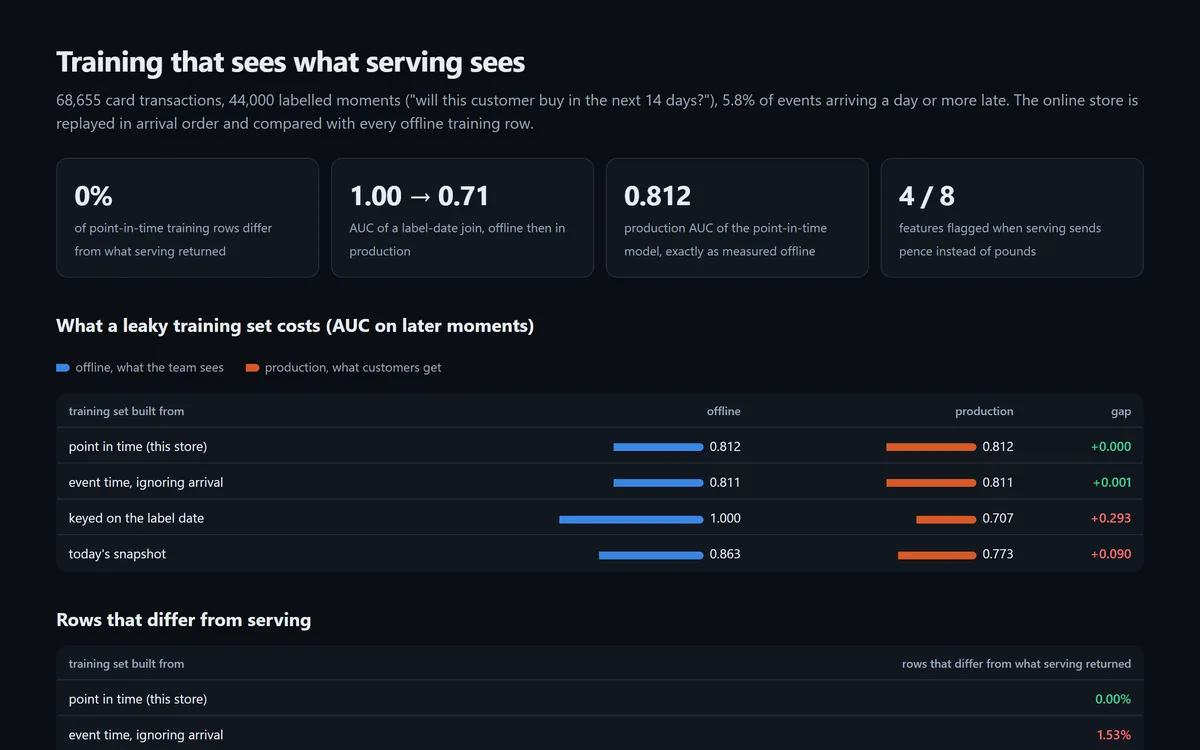
0 of 44,000training rows that differ from what the online store served; offline AUC equals production AUC
1.00 to 0.71AUC of a label-date join offline and in production (honest model: 0.81 in both)
4 of 8features flagged when serving sends pence instead of pounds; the others stay quiet
demo Demo tour
Screenshots from the running application, with its synthetic demo data. Select one to enlarge.


01 The problem
Models are trained on features computed one way and served features computed another. Joining today's feature table to old labels, or keying labels by the date the outcome was recorded, quietly leaks the future: the model looks brilliant offline and disappoints in production. Unit bugs in serving go unnoticed because models never crash.
02 How it works
- Events arrive (some late)
- Feature views defined once
- Point-in-time training set
- Online store, arrival order
- Replay proves they match
- PSI flags serving skew
03 What I built
- Declarative, versioned window features with one aggregation function shared by the offline and online stores.
- Point-in-time training sets built as known at each moment (event time inside the window and arrival time before the moment), and an online store replayed in arrival order to prove they match.
- Training/serving skew detection with the population stability index per feature.
04 What I learned
Keying labels by the date the outcome was recorded gave a perfect offline AUC and a production AUC below the honest model; the leak looks exactly like a win.
Writing the online store independently and replaying the stream is the cheapest proof that training and serving agree.
05 Known limitations
Every repository documents what it doesn't do yet. The main ones:
- In-memory stores; production needs a warehouse as-of join and a key-value store.
- Window aggregations over one entity only.
06 Stack
PythonNumPyscikit-learnFeature engineeringMLOps
The repository has the design document, operations runbook, full evaluation report and known limitations. All data is synthetic, generated by code in the repository.
run Run it yourself
Every project runs on a laptop: no cloud account and no paid API needed.
git clone https://github.com/codeROCK-IZZY/feature-store.git
cd feature-store
pip install -e ".[dev]" && pytest
featurestore evaluate --gate          # writes eval/reports/report.html
featurestore lookup 7 --at 80