Machine learning · recs.apiCI passing
Recommender System
Recommendations measured honestly: strong baselines, a temporal split, cold start and serving.
View the code Evaluation report Demo tour Run it ›_ last push 5 days ago
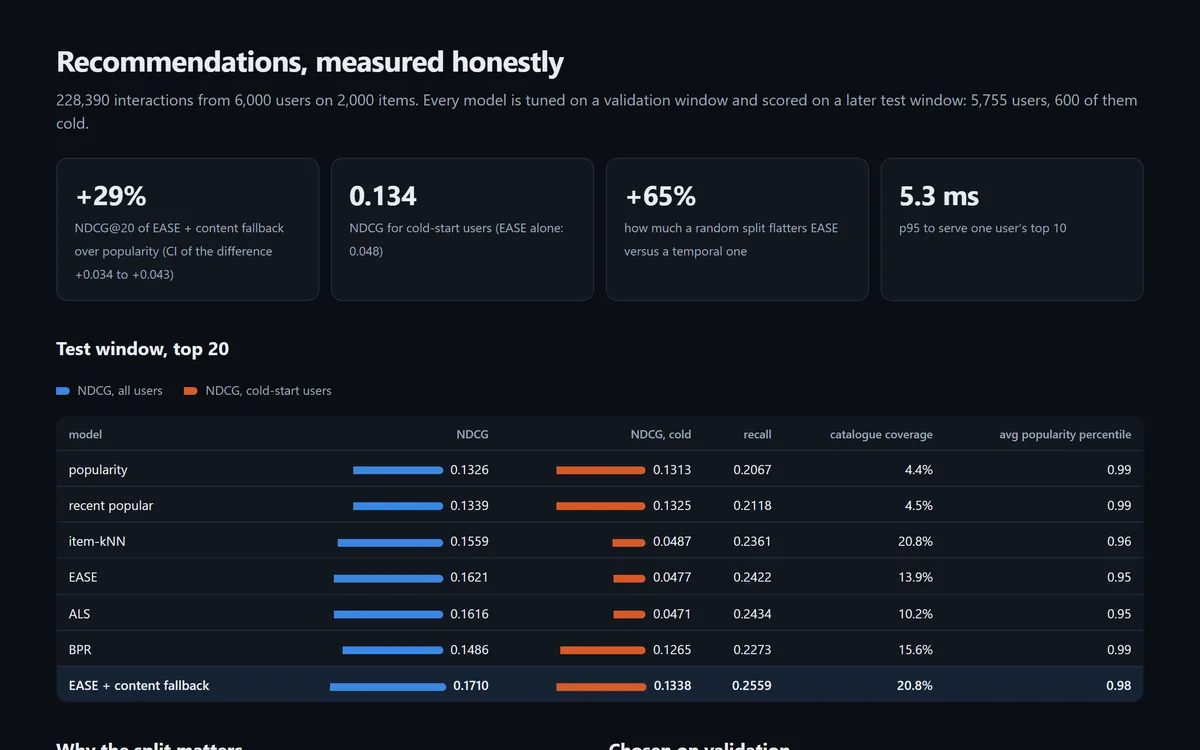
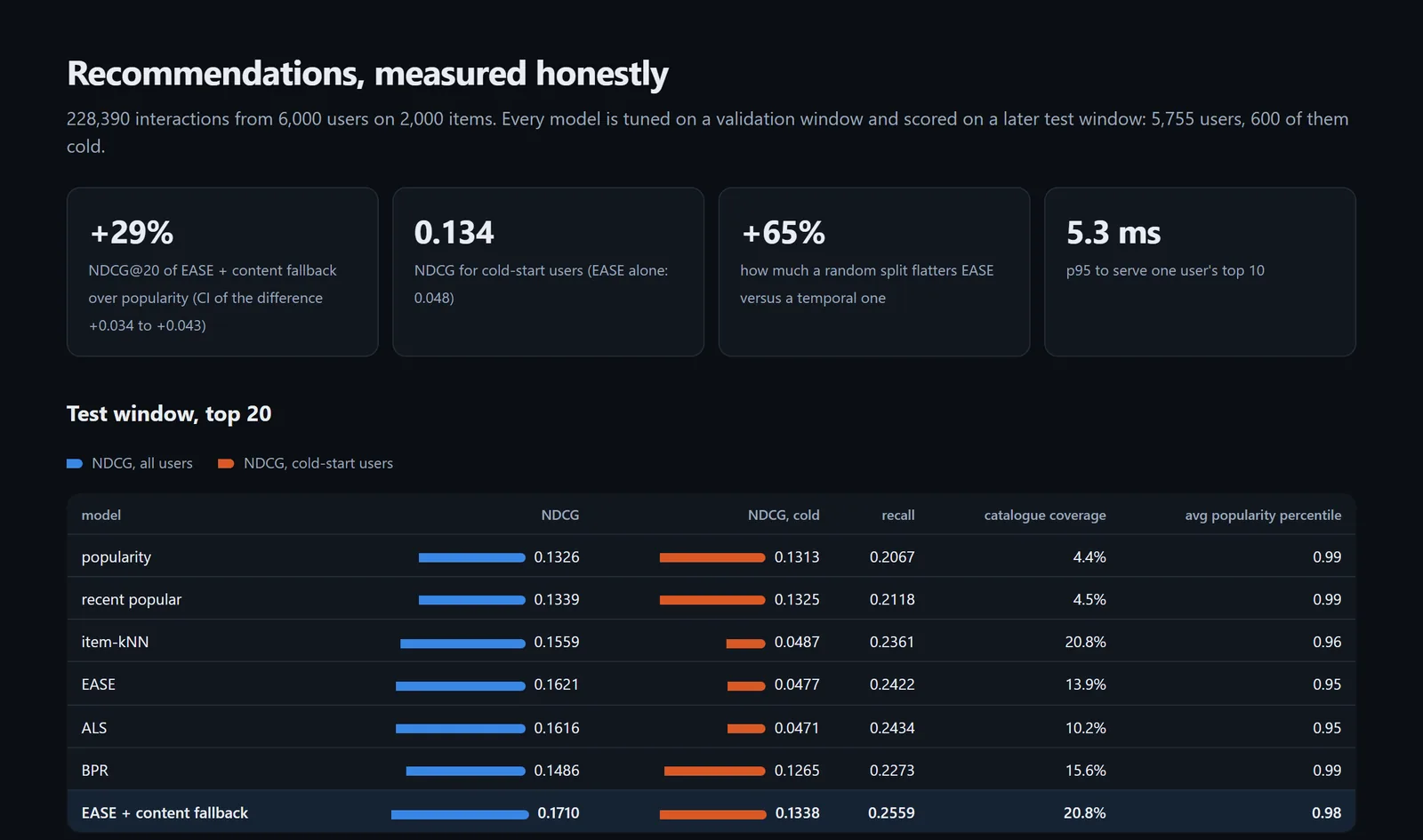
+29%NDCG@20 over popularity (95% CI of the per-user difference +0.034 to +0.043)
2.8xNDCG for cold-start users with the content fallback (0.134 against 0.048 for EASE alone)
+65%how much a random split flatters the model compared with the temporal split it will face
demo Demo tour
Screenshots from the running application, with its synthetic demo data. Select one to enlarge.

01 The problem
Recommender results are easy to flatter: a random train/test split lets the model learn from the future, hyperparameters get tuned on the test set, and popularity, the baseline that matters, is left out. New users with no history are where most models quietly fail.
02 How it works
- Interactions up to today
- EASE fitted (closed form)
- Content fallback for thin history
- Remove what the user has
- Top-K in ~5 ms
- Scored on the next 30 days
03 What I built
- Popularity, item-kNN, EASE, implicit ALS and BPR, each tuned on a validation window and scored once on a later test window, with paired bootstrap intervals over users.
- A cold-start hybrid that blends content (genre affinity) and popularity with the collaborative model, weighted by how much history a user has.
- A serving API for one user's top-K and similar items, with catalogue coverage and popularity bias reported next to accuracy.
04 What I learned
ALS first looked worse than popularity; a wider grid on the validation window (much stronger regularisation) put it level with EASE. Weak baselines usually mean weak tuning.
Collaborative models score a third of popularity on users with three or fewer interactions; blending by history length fixes cold start without hurting anyone else.
05 Known limitations
Every repository documents what it doesn't do yet. The main ones:
- Synthetic interactions and offline metrics; an online A/B test is the real judge.
- Genre is the only content feature, so items released after training are still hard to recommend.
06 Stack
PythonNumPySciPy sparseFastAPI
The repository has the design document, operations runbook, full evaluation report and known limitations. All data is synthetic, generated by code in the repository.
run Run it yourself
Every project runs on a laptop: no cloud account and no paid API needed.
git clone https://github.com/codeROCK-IZZY/recommender-system.git
cd recommender-system
pip install -e ".[dev]" && pytest
recsys evaluate --gate                # writes eval/reports/report.html
recsys recommend 42
recsys serve                          # GET /users/42/recommendations