Cloud & platform · fleet.k8sCI passing
Enterprise Kubernetes Management
Fleet management for Kubernetes: policies that read manifests the way the API server does, proven fixes, rightsizing and upgrade blockers.
Open the live demo View the code Evaluation report Demo tour Run it ›_ last push 2 days ago
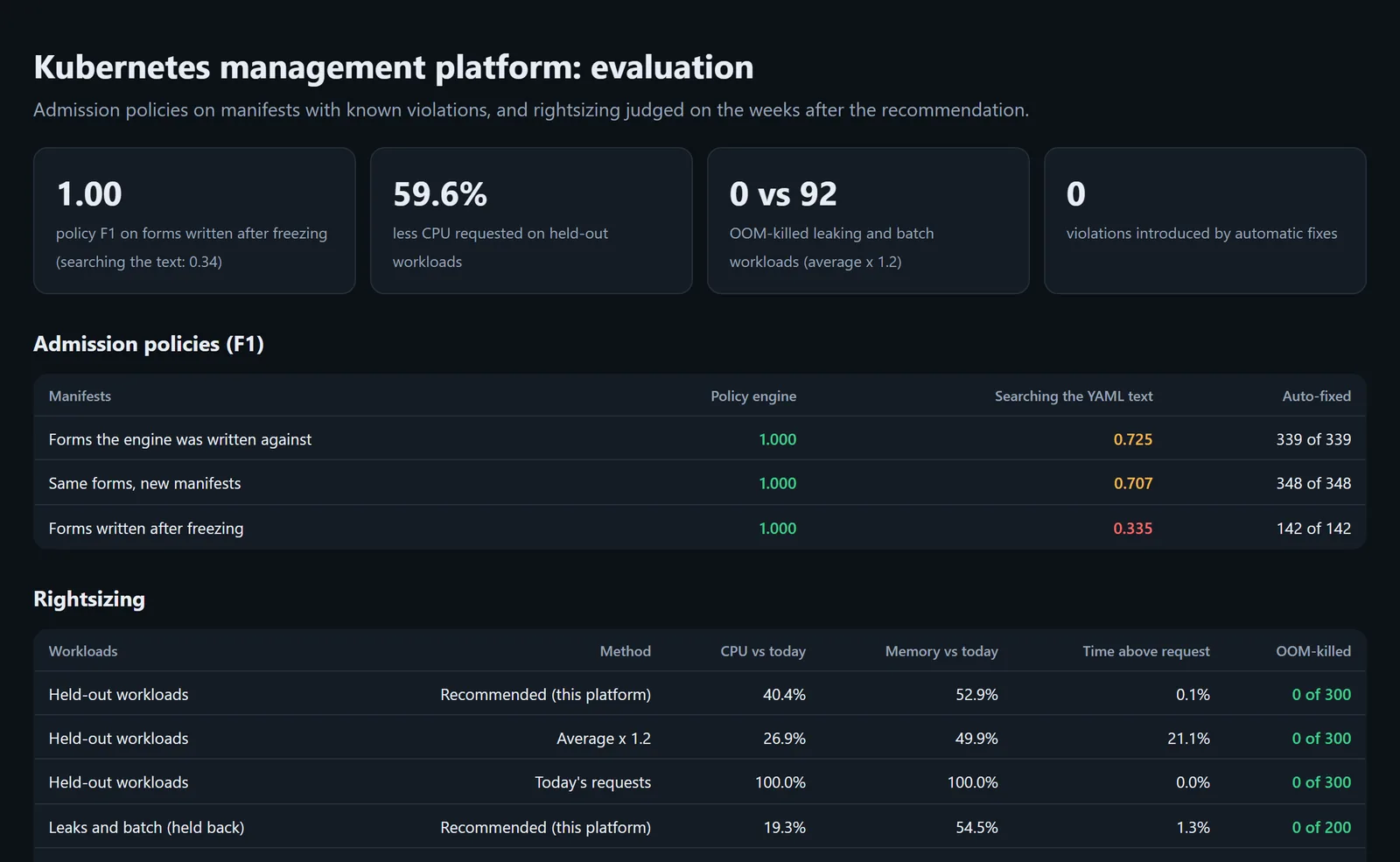
1.00 vs 0.34policy F1 on manifest forms written after freezing (searching the YAML text)
0 vs 92OOM-killed workloads of 200 bursty ones (average x 1.2 rule)
40%of today's CPU requests, with workloads above request 0.1% of the time
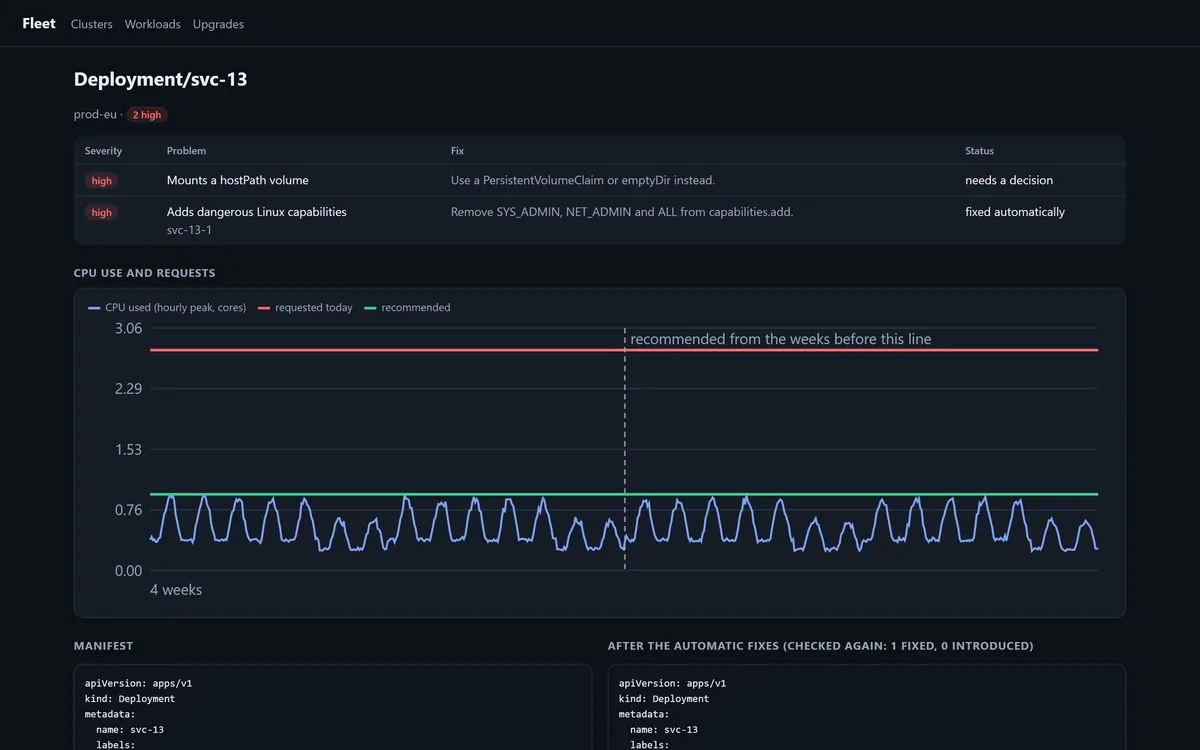
demo Demo tour
Screenshots from the running application, with its synthetic demo data. Select one to enlarge.
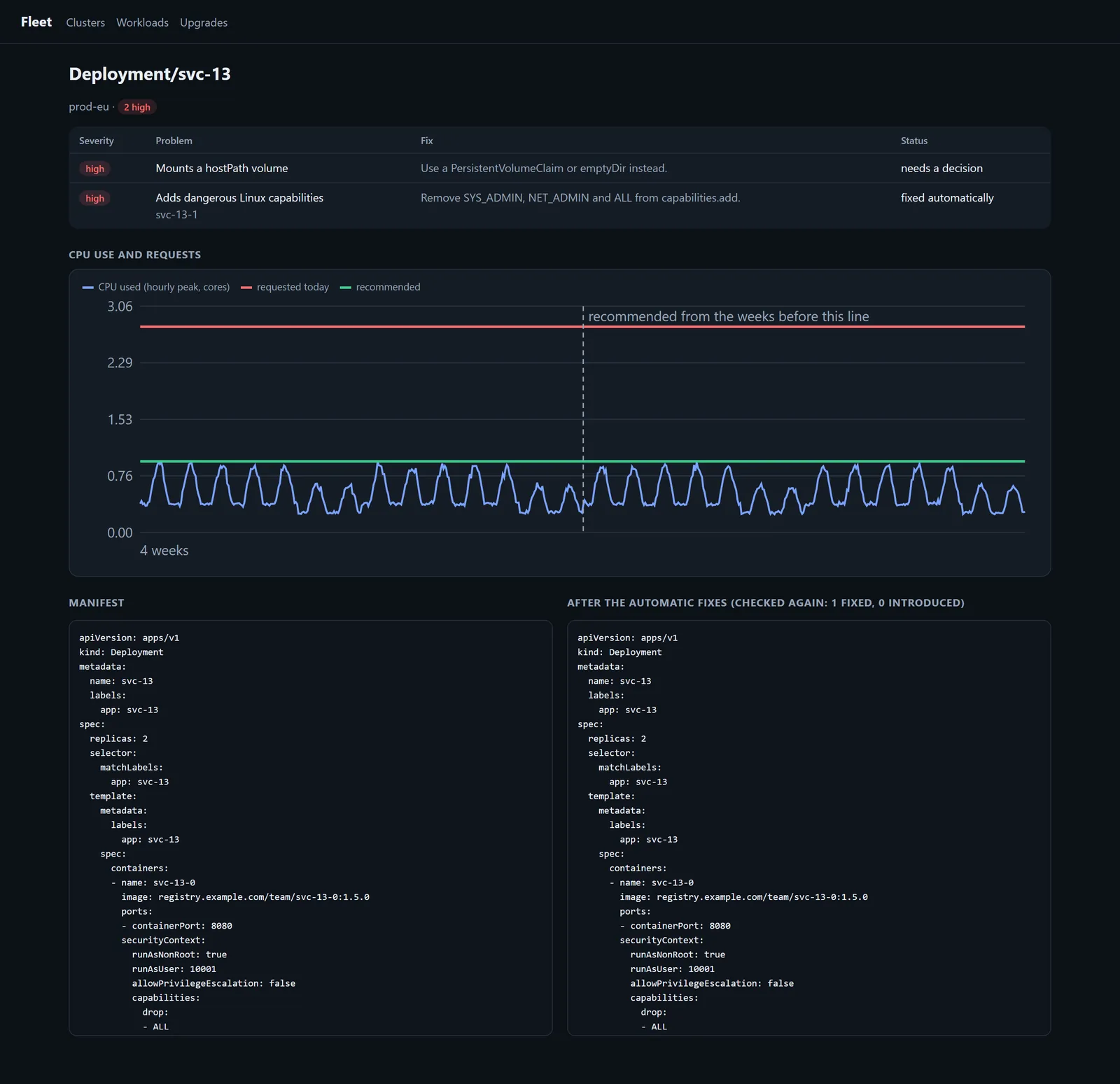


01 The problem
Teams running several clusters ship manifests nobody checks properly (text-matching linters miss violations in CronJobs and init containers, and flag safe settings), request two to four times the CPU they use, and find out about removed APIs when an upgrade breaks production.
02 How it works
- Manifests
- Parse and unwrap pod specs
- Policies
- Verified fixes
- Usage history to requests
- Upgrade blockers
03 What I built
- An admission policy engine on parsed objects: every workload kind unwrapped to its pod spec, init and ephemeral containers, pod-to-container security inheritance, image digests and registry ports, multi-document YAML, anchors and JSON.
- Fixes accepted only after the engine checks the result again: automatic for the safe rules, and Claude-proposed JSON Patches limited to allowed fields for the rest.
- Rightsizing from usage history judged on the following two weeks, memory set from the peak plus trend with request = limit, and upgrade blockers for APIs removed between a cluster's version and its target.
04 What I learned
Text search flagged 'ALL' in capabilities.drop as dangerous and asked CronJobs for probes; reading objects the way the API server does removed both kinds of mistake.
The held-back run showed all out-of-memory kills came from batch bursts: the simulated leak was too slow, so leak handling is shown by a unit test and the gap is documented rather than retuned.
05 Known limitations
Every repository documents what it doesn't do yet. The main ones:
- No live cluster connection; manifests and usage are generated.
- Batch bursts are throttled 1.2% of the time under the recommended limits.
06 Stack
PythonKubernetesPyYAMLNumPyClaude APIFastAPI
The repository has the design document, operations runbook, full evaluation report and known limitations. All data is synthetic, generated by code in the repository.
run Run it yourself
Every project runs on a laptop: no cloud account and no paid API needed.
git clone https://github.com/codeROCK-IZZY/kubernetes-management-platform.git
cd kubernetes-management-platform
pip install -e ".[dev]" && pytest
kubefleet evaluate --gate                  # writes eval/reports/report.html