Cloud & platform · maint.keyholdCI passing
Property Management SaaS
Maintenance triage that gets a Friday-night emergency to someone in hours, and a rent ledger that never piles fees on tenants who paid.
Open the live demo View the code Evaluation report Demo tour Run it ›_ last push 1 day ago
97% vs 51%of emergencies attended within 4 hours, triage vs inbox order, on phrasings written after the freeze
90% vs 15%of emergency messages caught on unseen wording, triage vs keyword rules (19% false alarms)
0 vs 1,756late fees charged while all rent was paid: rent-first vs oldest-first allocation

demo Demo tour
Screenshots from the running application, with its synthetic demo data. Select one to enlarge.
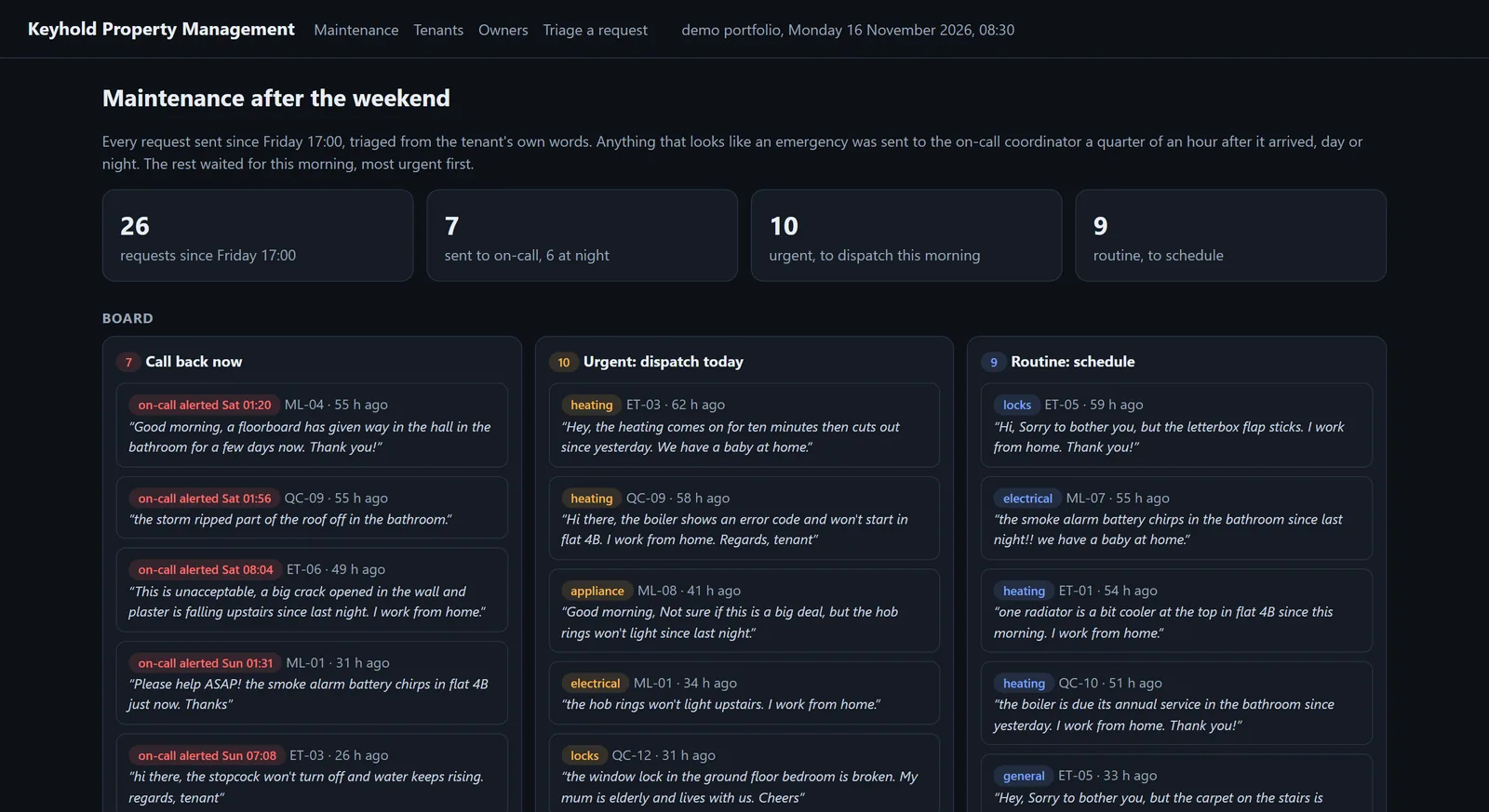


01 The problem
Tenants report problems in their own words at any hour, and the office reads the inbox on weekdays. Keyword rules follow the tenant's tone, not the problem, so a burst pipe described calmly waits until Monday. On the money side, applying payments strictly oldest first lets one unpaid late fee eat into every later month's rent, so a tenant who pays in full is charged a fee every month and shown owing rent.
02 How it works
- Tenant message
- Hazard screen
- Urgency + trade model
- On-call or inbox
- Rent ledger
- Owner statement
03 What I built
- Triage of each request into urgency and trade: a hazard lexicon (water escaping, heat or fire, gas, no power, security, structure, cold) as a screen and as features for numpy logistic regressions, with settings chosen by cross-validation that holds out whole phrasings.
- A dispatch simulation of a portfolio's month (inbox read three times each weekday, on-call call-backs for flagged requests) to measure how long emergencies wait under each policy.
- A rent ledger in whole cents: proration by days let, one late fee per month after grace, payments to rent before fees, credit carried forward, and owner statements; plus a FastAPI console and an optional Claude second reading that may raise urgency but never lower it.
04 What I learned
A word model was perfect on new messages that reused its training sentences and caught 30% of emergencies on new phrasings; splitting by phrasing, not by message, exposed it.
A fresh phrasing set written after the freeze commit is the test; one limit set in advance (night false alarms 3.0 a week) was missed at 3.1 and reported, not tuned away.
The console caught 'smoke alarm battery chirps' flagged as fire; equipment names are now ignored by the screen, every bank was rerun and the change is in the ADR.
05 Known limitations
Every repository documents what it doesn't do yet. The main ones:
- Synthetic messages by one author; real tenant messages would be the real test.
- The dispatch simulation assumes contractors are always available; Claude's reading is not measured.
06 Stack
PythonFastAPINumPyClaude APIDocker
The repository has the design document, operations runbook, full evaluation report and known limitations. All data is synthetic, generated by code in the repository.
run Run it yourself
Every project runs on a laptop: no cloud account and no paid API needed.
git clone https://github.com/codeROCK-IZZY/property-management-saas.git
cd property-management-saas
pip install -e ".[dev]" && pytest
propman evaluate --gate                    # writes eval/reports/report.html